

If you have been told you are “double-jointed,” or you have joints that slip, sprain, or ache more than seem reasonable, you may have already run into the terms HSD and hEDS. They are often used interchangeably online, and they are not the same thing. I want to lay out what each one means, how they are evaluated, and why I look for them in patients with POTS.

Joint hypermobility, HSD, and hEDS are different things
Joint hypermobility simply means your joints move beyond the typical range. Many people have it and never have a problem. When hypermobility comes with symptoms such as recurrent joint pain, subluxations, fatigue, or injuries that heal slowly, it may fall under Hypermobility Spectrum Disorder (HSD). Hypermobile Ehlers-Danlos Syndrome (hEDS) is a more specific diagnosis with defined criteria.
HSD is sometimes read as a lesser or “almost” diagnosis, and I do not think of it that way.
HSD can cause real pain and real limitation, and it is treated with the same seriousness as hEDS.
How hEDS is diagnosed
The 2017 international criteria for hEDS have three parts. The first is generalized joint hypermobility, usually measured with the Beighton score, a 9-point exam in which adults under 50 typically need a score of 5 or more (the threshold changes with age). The second is a set of additional features, including family history and findings involving the skin, connective tissue, and musculoskeletal system. The third is the exclusion of other conditions that could explain the picture.
Unlike some other types of Ehlers-Danlos syndrome, hEDS does not have an identified genetic marker, so there is no blood test that confirms it. Genetic testing is used when the picture raises the question of a different connective tissue condition, and the hEDS diagnosis itself rests on a careful clinical exam.
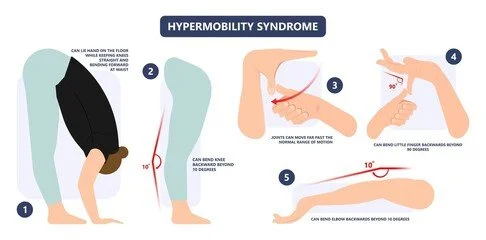
How hypermobility relates to POTS
The link between joint hypermobility and POTS is well documented, and the 2019 NIH consensus includes examining for hypermobile features as part of a POTS evaluation. That is why I ask about joint hypermobility at every POTS evaluation. These are separate conditions with separate evaluations, and having one does not mean you have the other.
What I can do by video, and what needs an in-person exam
I start with a video-guided joint assessment during your visit. If the screen is positive, I can diagnose HSD directly, and we can begin treatment that same day.
A definitive hEDS diagnosis requires a hands-on skin and joint exam that I cannot do by video. If your presentation looks more like hEDS, I will refer you to rheumatology or genetics for that part of the evaluation, and your treatment continues in the meantime so you are not waiting on that appointment to start feeling better.
What management looks like
Treatment focuses on protecting and strengthening your joints and on managing whatever else comes with the condition. In practice, that often includes:
A physical therapy referral, ideally with someone familiar with hypermobility, to build stability and proprioception without pushing joints to the end of their range.
Strengthening that stays within a safe range, rather than stretching, which many hypermobile patients are told to do and often does not help.
Joint protection strategies, and bracing or taping when it makes sense for a specific joint.
Pacing your activity so a good day does not turn into a week of recovery.
Attention to the other things that commonly travel with hypermobility, such as fatigue, digestive symptoms, easy bruising, and orthostatic symptoms.
If you also have POTS, the exercise plan is shaped around both, which is one more reason to look at the whole picture instead of one diagnosis at a time.
What this means for you
If your joints have been a lifelong puzzle, or your symptoms have been dismissed because your imaging and labs look normal, a careful history and exam can give you real information. You can learn more about a POTS evaluation here, or book a visit to get started.